

How The News Minute's Woke Agenda Is Cancelling Science
TNM set out to fact-check a Malayalam channel and never fact-checked itself. We checked both sides, paper by paper, down to the data tables. The result: one real error by UA, twelve by TNM, and a story that labelled the speakers' religion before it tested a single citation.
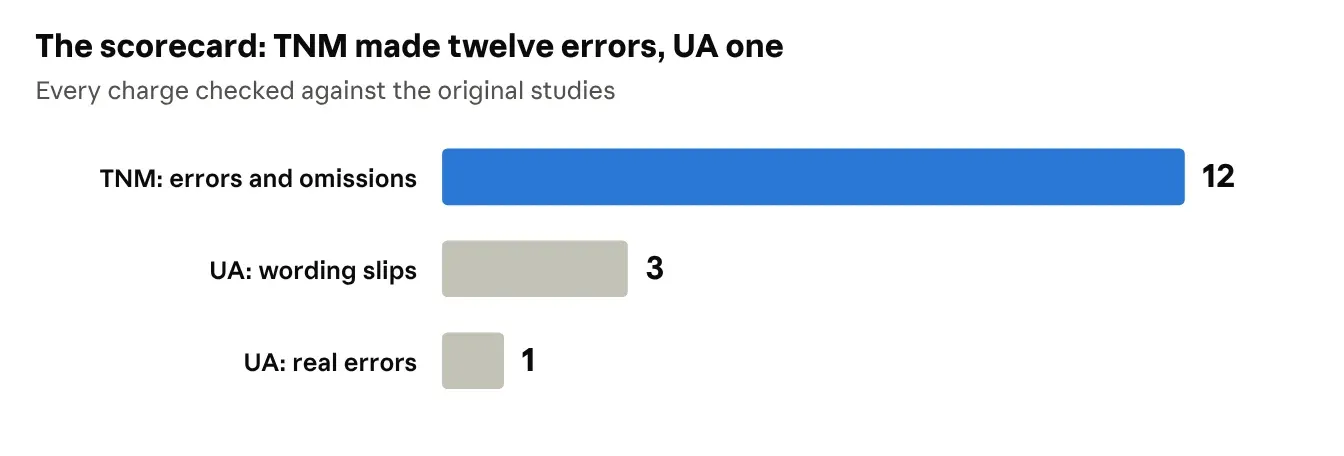
Yes Kerala count, this article. Each item is sourced below.
On 20 November, The News Minute published a long investigation headlined "Unmasking misogyny: How a Malayalam YouTube channel weaponises science against women." The channel is Unmasking Anomalies. TNM's pitch was simple: it had followed the channel's citations back to the original research and found that the science didn't hold up.

TNM's header illustration for the story: the UA logo on a faceless figure at a YouTube podium. Image: The News Minute.
We are Yes Kerala. We did what TNM said it did: we pulled every paper, read past the abstracts, and checked the tables. Then we did the one thing TNM didn't do: we fact-checked the fact-checker.
What we found isn't the clean story TNM sold. Most of what TNM called UA's errors doesn't survive a check against the original studies. The one that does, we name plainly. TNM got more wrong. Some of its errors are careless. Some are at the core of its argument. And around them, TNM built a frame that introduced a religious label before any of the science was examined.
Here's the record, round by round.
TNM refuted a claim Ameer never made
TNM's whole investigation is built on one TV moment: Muhammed Ameer on 24 News' Thammil Thammil, citing frustration-aggression theory. TNM opens with that clip and keeps coming back to it.

Muhammed Ameer on 24 News' Thammil Thammil. Screengrab: 24 News, via Unmasking Anomalies.
Here is what TNM leaves its readers to assume: that Ameer called sexual frustration the cause of rape. Read TNM's piece closely. Nowhere does it quote him saying that. He offered it as one factor among several that can feed into sexual violence. That's a modest, defensible claim, and it's what the research he was relying on says.
TNM's big punch is that Adam Lankford, the criminologist behind the theory, says sexual frustration is not by itself a sufficient explanation for violence. That's true, and it's in the paper. But Ameer never said it was sufficient. TNM took Lankford's caveat and swung it at a claim Ameer never made. That's a strawman, and it's the foundation the rest of TNM's story is built on.
It gets worse for TNM. It mocks Ameer's "boss and home" example, the man who can't shout at his boss so he takes it out on someone at home. TNM says Lankford is "clearly not establishing" that frustration gets displaced onto another person. But displacement is the textbook core of the theory. The 1939 frustration-aggression hypothesis is also known as the frustration-aggression-displacement theory. In the standard account of the theory, when the source of frustration can't be challenged, "the aggression gets displaced onto an innocent target." That is Ameer's example almost word for word.
Lankford's own 2021 paper in the Journal of Criminal Justice says the same in its abstract. It ties sexual frustration to aggression, violence and crime "associated with relief-seeking, power-seeking, revenge-seeking, and displaced frustration." TNM says it read this paper "in detail" and still told readers displacement wasn't there.
TNM's own Instagram carousel, published with Newslaundry, sums up Ameer's argument accurately: men exposed to sexual imagery become sexually frustrated, and that frustration can be "displaced onto others." Then it tells readers the research he cites "does not establish this explanation at all." Lankford's abstract names displaced frustration in plain words. TNM described Ameer's argument correctly, and then said the source didn't support it when it does.
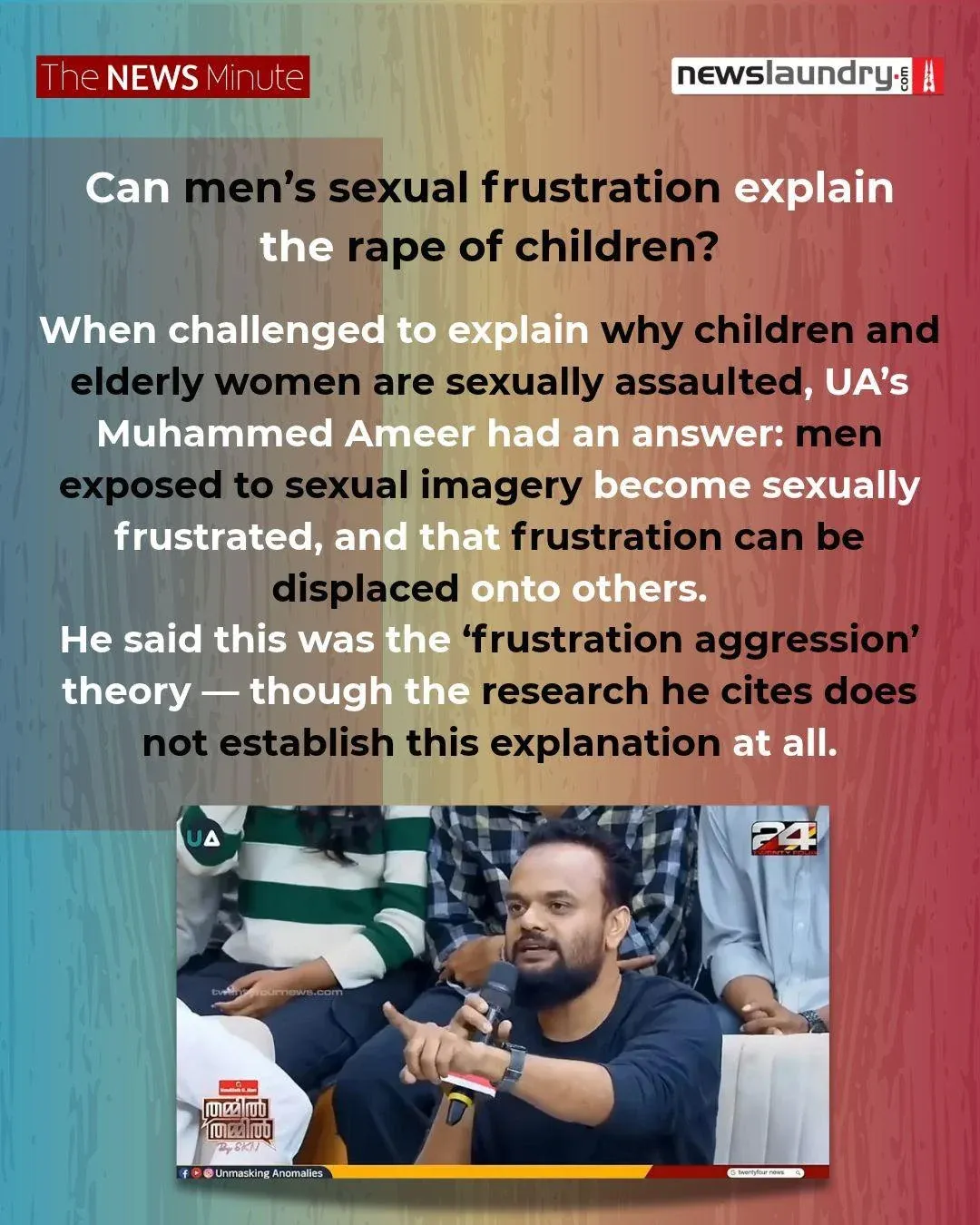
TNM's own slide: it describes frustration "displaced onto others," then says the research doesn't support it. Lankford's abstract says it does. Image: The News Minute / Newslaundry, Instagram.
Then TNM says the theory has no empirical support. That's true of the 2021 paper itself, which is a theory paper. But in 2024 Lankford and Jason Silva tested the theory on 178 US public mass shooters (Homicide Studies). They found shooters with sexual frustration problems were more likely to be misogynistic and caused more victims on average. The theory was tested and it held up, and TNM never mentions it.
Then there's the arousal study Lankford cites: Dan Ariely and George Loewenstein's The Heat of the Moment (2006). TNM discusses one question, whether men could imagine being attracted to a 12-year-old girl, and reminds readers that attraction isn't assault. Fair enough. But the same paper has a full table on coercion, and TNM reported none of it. On a 0-100 scale, men's willingness to keep pushing for sex after a woman says "no" rose from 20 when calm to 45 when aroused. Willingness to slip a woman a drug rose from 5 to 26, about five times higher. In a debate about sexual violence, that is the most relevant finding in the paper, and TNM left it out.
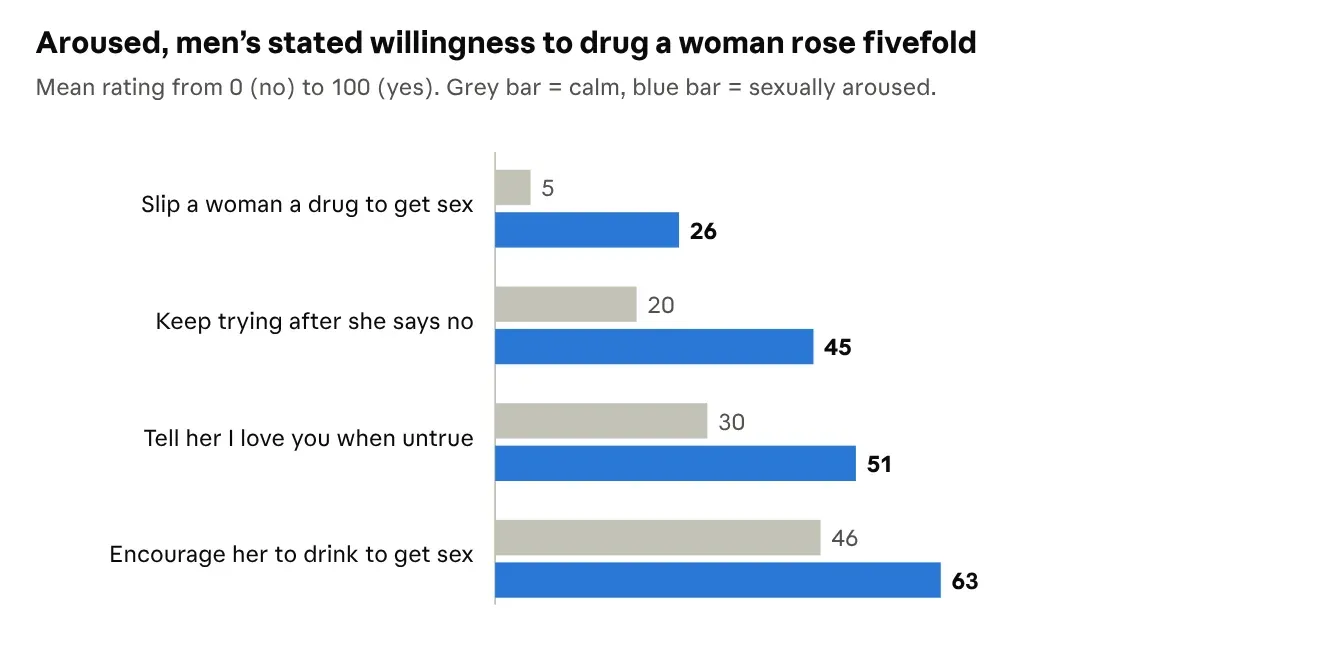
Source: Ariely and Loewenstein (2006), Journal of Behavioral Decision Making 19(2), Table 3. Hypothetical self-reports by male Berkeley undergraduates.
To be clear about the limits: Ariely's sample was 35 Berkeley students answering hypothetical questions, and it says nothing about clothing. Nobody should use it to argue that a hoarding causes rape. But TNM didn't say the evidence was limited. It said the evidence wasn't there, and it was.
The religious label came before the evidence
Now look at how TNM built the piece.
It opens with the clip. Then, before testing a single citation, TNM pauses to introduce the channel to its readers. The first thing they learn is that UA is an Islamic theological group. Every scientific question after that is read through that label.
What does a speaker's religion have to do with whether Lankford's abstract mentions displaced frustration? Nothing. A citation is right or wrong whether the person quoting it prays five times a day or never. Peer reviewers judge a paper on its evidence, not the author's faith, and journalists checking citations should do the same. TNM put the religious label first and the papers second.
“A citation is right or wrong whether the person quoting it prays five times a day or never.”
The same framing went out on social media. In the carousel promoting the story, TNM told its followers that UA's work suggests women who dress in certain ways are not really exercising agency "unless they stick to religion." Those are TNM's words, not UA's. A debate about culture and choice, which feminist scholars like Jeffreys and Bartky have had for decades, was presented to TNM's audience as a story about religion.
Then comes the guilt by association. TNM moves from UA to the "scientific blackpill," then to the manosphere, then to incel forums that misuse Thornhill and Palmer, and finally to Andrew Tate, through the alleged funders of a tradwife influencer whose face UA had blurred in a reaction video. TNM concedes along the way that UA is "not simply a blackpill platform," but by then the damage is done. A Malayalam channel whose speakers include a dentist, a clinical psychologist and a medical doctor has been placed in the same story as Andrew Tate.
Look at who TNM relied on. Its main expert voice is Darsana Varier, a declared critic who debated UA on its own channel. Its other named voice, Aysha Mahmood, has opposed the channel since its early days on Clubhouse. Both are entitled to their views. But when an investigation's main voices are the subject's opponents, it owes the subject a full chance to answer. Instead, TNM's last line says it has "reached out to Abdulla Basil CP" and will update the story if he responds. TNM published first and asked for his side afterwards. And Basil is the only person TNM says it contacted. Muhammed Ameer, CP Abdu Samad and Hilal Saleem, whose words TNM takes apart at length, are not mentioned as having been asked anything.
Criticise the science. We're doing exactly that, to both sides. But when a story names the speakers' religion before testing their citations, relies on their opponents, and asks for a response only after publishing, readers are entitled to ask whether this was a fact-check or a framing exercise.
TNM's charges against UA, checked against the studies
TNM's piece left readers with a list of UA "errors." We took each one back to the original research. Most of them fall apart under that check. Only one holds up as a real error, and we name it plainly below.
"35% of men are potential rapists": the number stands
In Neil Malamuth's 1981 research, men were asked how likely they would be to rape a woman if they could be sure of not being caught or punished. The paper's official abstract records the result: "On the average, about 35% indicated some likelihood of raping." That is what "potential" means: men who say they might do it, given the opportunity and no consequences.
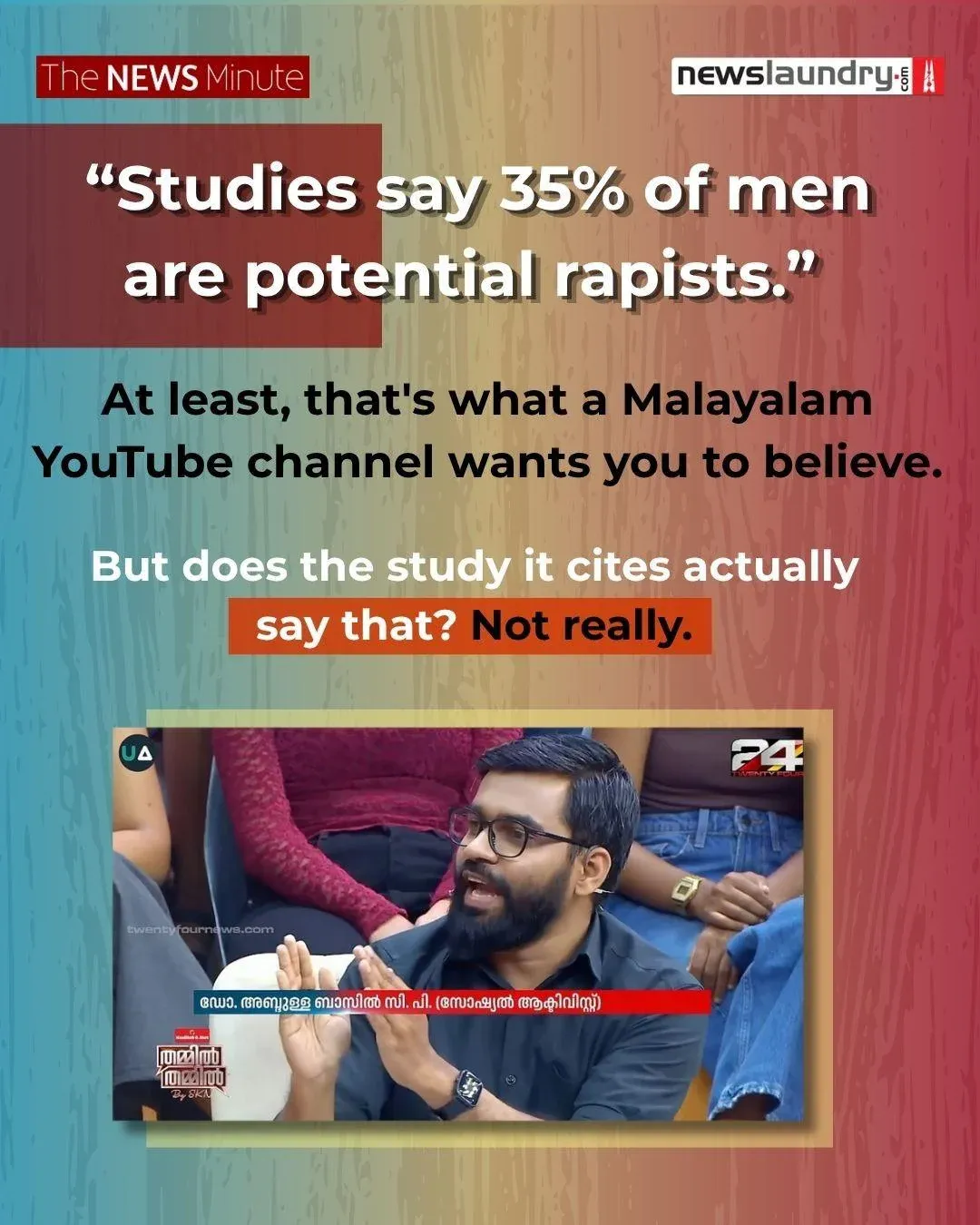
TNM's verdict on the 35% figure: "Not really." A 2014 study found 31.7%. Image: The News Minute / Newslaundry, Instagram.
TNM's objection is that Malamuth prefers the technical term "rape proclivity" to "potential rapist." That's an argument about vocabulary. It doesn't touch the finding.
The finding has also been replicated. In 2014, Sarah Edwards, Kathryn Bradshaw and Verlin Hinsz put similar questions to 86 male college students (Violence and Gender). If nobody would ever know and there were no consequences, 31.7% reported "intentions to force a woman to sexual intercourse." When the question used the word "rape," 13.6% still said yes. Thirty-three years apart, the result is the same. Both studies are small and drawn from college students, and UA's speakers cited further research on this point in later videos. But the number Basil used is real.
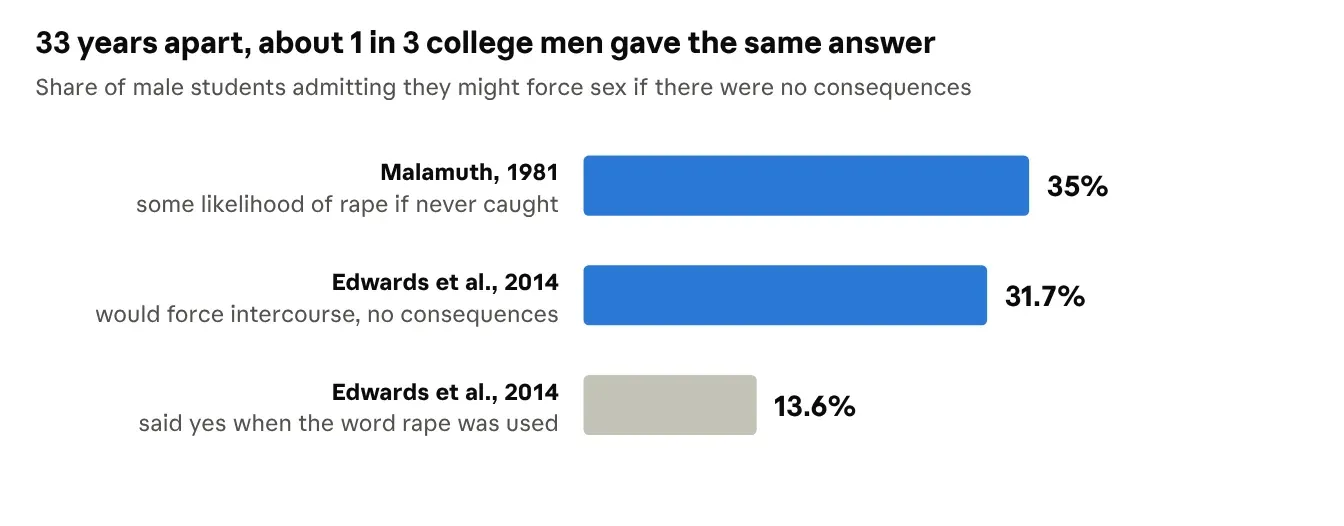
Sources: Malamuth (1981), Journal of Social Issues 37(4); Edwards, Bradshaw and Hinsz (2014), Violence and Gender. Both are samples of US college men.
"Men see sexualised women as objects": that's what the lead researcher reported
Basil's claim comes from Princeton psychologist Susan Fiske's research. Presenting it at the American Association for the Advancement of Science meeting in 2009, Fiske reported that pictures of bikini-clad women activated brain regions associated with objects or, in her words, "things you manipulate with your hands." National Geographic's headline put it bluntly: bikinis make men see women as objects, and the scans confirm it.
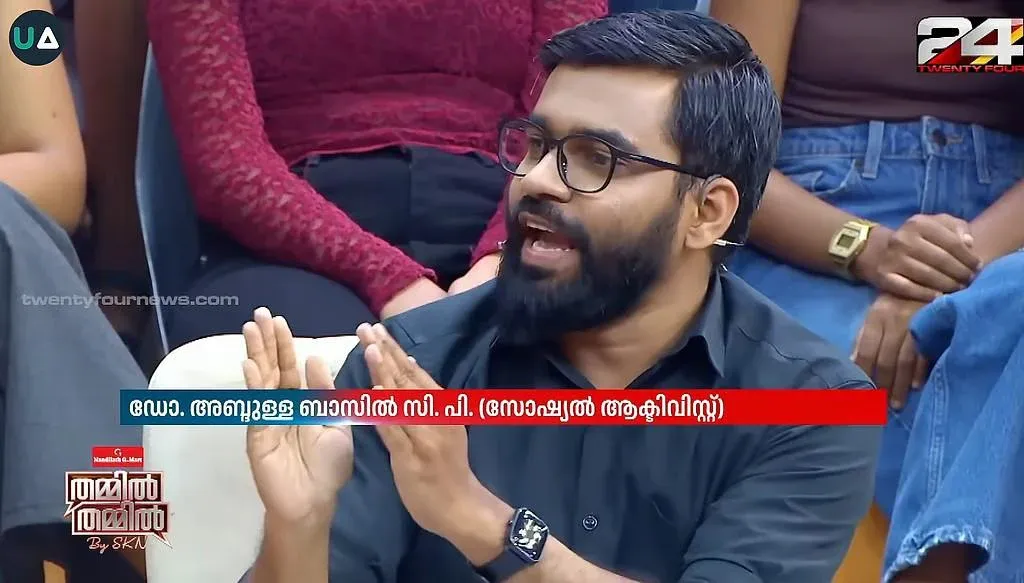
Abdulla Basil CP on 24 News' Thammil Thammil. Screengrab: 24 News, via Unmasking Anomalies.
Fiske named the regions as the premotor cortex and the posterior middle temporal gyrus, which light up when people anticipate using tools. Basil gave more weight to the postcentral gyrus than to those two. That was a slip in which brain region he emphasised, not in the finding. The researchers' own caveats apply: Fiske said some men may objectify sexualised women and that more research was needed, and the strongest effect, where the brain's mind-reading regions went quiet, appeared in men high in hostile sexism (Cikara, Eberhardt and Fiske, 2011). But Basil's central point is what the lead researcher herself said.
"Frustration-aggression theory": the source was named
TNM's own article admits that Ameer named Adam Lankford's 2021 paper as his source in later videos. Lankford's theory isn't a separate idea from the 1939 hypothesis. His paper says plainly that it builds on frustration-aggression research to propose a sexual frustration theory. Citing the parent theory and then the paper built on it isn't an error.
"The median age is about 15": right number, wrong word
Ameer said most women are raped between the ages of 12 and 25, with a median of about 15. His range is supported by TNM's own figures from Thornhill and Palmer: the highest rates were among women aged 16-24, followed by girls aged 12-15. The number 15 is supported too. In the largest analysis on this, nearly 300,000 US sexual assaults in the FBI's National Incident-Based Reporting System, "the modal age of victims was 15 years" (Felson and Cundiff, Archives of Sexual Behavior, 2014). The median in these datasets is higher, around 21. So Ameer said "median" where he meant "most common age." That's a wording slip, and the number itself is backed by the data. The same researchers also go further than Ameer did: they attribute adolescents' higher risk partly to sexual attractiveness, alongside vulnerability and exposure to offenders.
Homosexuality: what Basil actually argued
TNM presents Basil as claiming that homosexuality can be cured. His argument was about the history of how homosexuality was removed from psychiatric diagnostic manuals, and about people such as Mike Davidson who say their orientation changed. Pointing out that such people exist is not the same as claiming there is a reliable cure.
The science on this has its own limits. The American Psychological Association distinguishes sexual orientation from sexual orientation identity. Some people change how they identify or live, while the APA's 2009 review found that efforts to change orientation itself are "unlikely to be successful." Ex-gay testimonies are real testimonies, but they aren't scientific proof that orientation can be changed. Anyone citing them should say so.
The 27% figure: a loose label on a real number
Hilal's figure is real. The 2017 Williams Institute/UCLA study found that 27% of California youth aged 12-17 are "viewed by people at school as gender nonconforming." Hilal called this gender-related confusion. Strictly speaking, the study measured gender expression, meaning how masculine or feminine a teenager appears to others, not a clinical diagnosis. It also covered California, not "New York or somewhere." That's a loose label, and anyone repeating the figure should use the study's own term.
The substance of his concern is in the same study, though. UCLA reported that these youth "reported higher levels of psychological distress compared to their gender-conforming peers." More than one in four teenagers seen as outside gender norms, and more distressed than their peers: that's a legitimate thing to worry about. TNM didn't mention it.
Where UA actually slipped
The lie-detector challenge. It was a publicity stunt. It proved nothing about anyone's honesty and did UA more damage than it did to its critics.
So against TNM's charge sheet, UA's record is one real error and three wording slips: "median" where he meant the most common age, the brain region emphasised, and "gender confusion" for non-conformity. The rest of TNM's charges don't survive a check against the studies.
The twelve errors TNM didn't report
TNM held UA to a strict standard. Now TNM gets held to the same standard.
- It argued against a claim Ameer didn't make. Ameer offered sexual frustration as one factor. TNM refuted it as though he had called it the sole cause.
- It denied the displacement mechanism. Displacement is the classical core of frustration-aggression theory, and Lankford's own abstract lists "displaced frustration" as a pathway. TNM said it read the paper in detail and missed both.
- It said the theory had no empirical support, and left out the 2024 study that tested it on 178 mass shooters.
- It reported one question from the Ariely study and none of the coercion data, which is the part of the study that bears on sexual violence.
- It put Winnipeg in the United States. TNM describes Malamuth's participants as coming from "the Los Angeles, Stanford, and Winnipeg areas in the US." Winnipeg is in Manitoba, Canada. It's a small slip, but it sits in a paragraph lecturing others about reading sources carefully.
- It caught Basil's wrong book and missed his point. TNM is right that Sheila Jeffreys' The Industrial Vagina is about the sex trade, not fashion. But Jeffreys also wrote Beauty and Misogyny: Harmful Cultural Practices in the West. It has a chapter titled "Fashion and Misogyny," and her publisher describes its argument in these words: "beauty practices are not related to individual female choice or creative expression." Basil cited the wrong book, but his argument stands: a leading radical feminist does call the fashion and beauty industry misogynistic. TNM corrected the citation and never engaged the argument.
- It presented a disputed number as settled. TNM cites anthropologist Peggy Reeves Sanday's finding that 47% of 156 societies were "rape-free" as if it were established fact. In 1989, Craig Palmer re-examined the ethnographic records behind that label in the journal Ethnology and concluded that "the previous claims about societies are questionable". Palmer is not neutral, since he co-wrote the book TNM attacks. But TNM asked readers to weigh the uncertainty in UA's sources and didn't apply the same standard to its own.
- It answered a question about gender with a study about attraction. Hilal's concern was adolescent gender confusion. TNM's counter-study, Same-Sex Sexual Attraction Does Not Spread in Adolescent Social Networks, is about sexual attraction, not gender identity. Those are different questions. On youth gender identity, the NHS-commissioned Cass Review (2024) in England described the evidence base as "remarkably weak" and said the sharp rise in referrals needs to be understood. Raising that concern is mainstream medicine, not bigotry.
- It attacked a speaker instead of her claim. TNM spends paragraphs on Savanna Stone's politics, income and alleged funders, and none on whether her claim holds up. TNM itself acknowledges the research behind it is real. Stevenson and Wolfers (2009) found that "women's happiness has declined both absolutely and relative to men," across datasets and industrialised countries. The causes are open to debate. Who repeated the finding is irrelevant to whether it's true.
- It never said that Ameer described Thornhill and Palmer accurately. A Natural History of Rape does, in the words of its official abstract, recommend that young women "consider the biological causes of rape when making decisions about dress," appearance and social activities. TNM's real quarrel is with an MIT Press book. That's a fair quarrel, but it isn't proof that Ameer misused his source.
- It put words in UA's mouth. TNM summed up the channel's message as "science says women should stay at home and cover themselves." No UA speaker said that, yet TNM put it in quotation marks. Its own reporting says UA's hosts have repeatedly put responsibility for assault on men regardless of what a woman wears, and that Basil said on air that humans have free will and men must be taught control.
- It treated a replicated finding as a misrepresentation. TNM's case against Basil's "35%" rests on Malamuth's choice of words. It never told readers that a 2014 study found 31.7% of college men would force a woman into intercourse if there were no consequences.
That's twelve mistakes.
Where the evidence actually lands
The science doesn't give either side a clean win, so let's be straight about where it lands.
On clothing: this is where both sides overreach, so here is the evidence as it actually stands.
There is research on UA's side. In a 1991 survey of 581 US psychiatrists, a "highly significant majority" concluded that what a young woman wears may affect her risk (Vali and Rizzo). In a 2016 experiment, men reported more sexually aggressive intentions toward women shown in sexualised clothing than toward women shown in non-sexualised clothing (Blake, Bastian and Denson). Ariely's arousal data and Fiske's objectification findings point the same way: what men see changes what some men say they would do.
Studies of actual attacks tell a narrower story. Offenders picking a target look for signs of vulnerability in how a person walks and moves (Grayson and Stein, 1981). In India, NCRB data for 2021 shows that in reported rape cases, 96.8% of victims "knew the rapist beforehand." No study shows that covering up prevents rape across a whole society.
So the defensible position is this. Modest dress may reduce provocation and aggressive intent in some men, and UA is entitled to argue for it as one precaution among many. It is not proof that clothing causes rape or that covering up prevents it. Responsibility always belongs to the man who commits the crime. UA's hosts have said exactly that, and TNM's own reporting confirms it.
On values: modesty, family and faith are values people are free to hold and argue for openly. They don't need a brain scan to be legitimate, and no brain scan can prove them right. The trouble starts when someone presents a value as a lab result. UA did that at times. TNM did the reverse: it took a set of scientific disputes and turned them into a story about a religious group.
On choice: TNM's best point is that UA questions women's choices only when it dislikes them. The consistent answer is that every choice is shaped by culture: the bikini and the burqa, the career and the kitchen. Jeffreys and Bartky make this argument about Western beauty culture, and the logic doesn't stop there. Once both sides accept it, "my choice" doesn't end any argument, and each side has to defend its values on their merits. That's a debate worth having honestly.
The verdict
TNM promised to unmask a channel. We went back to the same sources and checked both sides.
Against the original studies, UA's record comes down to one real error and three wording slips, and we've listed them without excuses. TNM made twelve, including a strawman at the centre of its argument, a core mechanism of the theory it denied was there, the coercion data it left out, Winnipeg moved to the US, and a frame that put religion ahead of evidence.
If UA owns its one error and tightens its wording in public, it comes out of this stronger. TNM now has twelve corrections of its own to make.
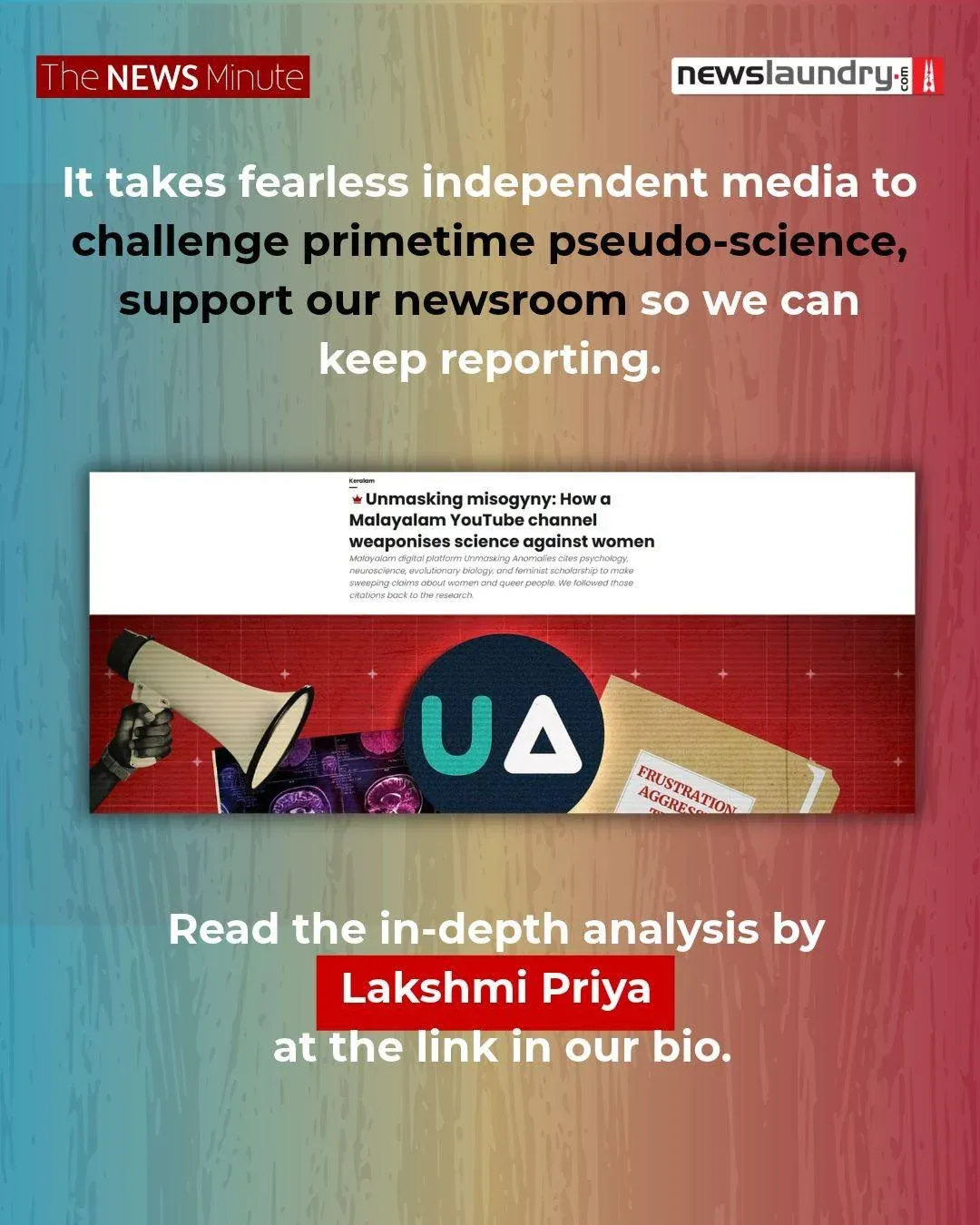
TNM asked readers to fund it to "challenge primetime pseudo-science." That's a fair standard, and TNM should meet it too. Image: The News Minute / Newslaundry, Instagram.
TNM asked readers to fund it to "challenge primetime pseudo-science." That's a fair standard, and TNM should meet it too.
Science doesn't belong to feminists or to believers. It belongs to whoever reads the whole paper. TNM didn't. We did.
Sources
- Lakshmi Priya, "Unmasking misogyny: How a Malayalam YouTube channel weaponises science against women," The News Minute, 20 November 2026.
- Dollard, J. et al. (1939). Frustration and Aggression. Yale University Press.
- Lankford, A. (2021). A sexual frustration theory of aggression, violence, and crime. Journal of Criminal Justice, 77, 101865.
- Lankford, A. & Silva, J. (2024). Sexually frustrated mass shooters. Homicide Studies, 28(2), 196-219.
- Ariely, D. & Loewenstein, G. (2006). The heat of the moment. Journal of Behavioral Decision Making, 19(2), 87-98.
- Malamuth, N. (1981). Rape proclivity among males. Journal of Social Issues, 37(4), 138-157.
- Edwards, S. R., Bradshaw, K. A. & Hinsz, V. B. (2014). Denying rape but endorsing forceful intercourse: Exploring differences among responders. Violence and Gender.
- Fiske, S. T. et al. (2009). Presentation, AAAS Annual Meeting, Chicago (reported by National Geographic, 16 February 2009).
- Cikara, M., Eberhardt, J. L. & Fiske, S. T. (2011). From agents to objects. Journal of Cognitive Neuroscience, 23(3), 540-551.
- Felson, R. B. & Cundiff, P. R. (2014). Sexual assault as a crime against young people. Archives of Sexual Behavior (published online 2013).
- Thornhill, R. & Palmer, C. (2000). A Natural History of Rape. MIT Press.
- APA Task Force on Appropriate Therapeutic Responses to Sexual Orientation (2009).
- Wilson, B. D. M. et al. (2017). Characteristics and mental health of gender nonconforming adolescents in California. Williams Institute / UCLA.
- Jeffreys, S. (2015). Beauty and Misogyny: Harmful Cultural Practices in the West, 2nd ed. Routledge.
- Sanday, P. R. (1981). The socio-cultural context of rape. Journal of Social Issues, 37(4), 5-27.
- Palmer, C. (1989). Is rape a cultural universal? Ethnology, 28, 1-16.
- Brakefield, T. A. et al. (2014). Same-sex sexual attraction does not spread in adolescent social networks. Archives of Sexual Behavior, 43(2), 335-344.
- Cass, H. (2024). Independent Review of Gender Identity Services for Children and Young People: Final Report.
- Stevenson, B. & Wolfers, J. (2009). The paradox of declining female happiness. American Economic Journal: Economic Policy, 1(2), 190-225.
- Vali, D. & Rizzo, N. D. (1991). Apparel as one factor in sex crimes against young females: Professional opinions of U.S. psychiatrists. International Journal of Offender Therapy and Comparative Criminology, 35(2), 167-181.
- Blake, K. R., Bastian, B. & Denson, T. F. (2016). Perceptions of low agency and high sexual openness mediate the relationship between sexualization and sexual aggression. Aggressive Behavior.
- Grayson, B. & Stein, M. (1981). Attracting assault: Victims' nonverbal cues. Journal of Communication, 31(1), 68-75.
- National Crime Records Bureau, Crime in India 2021.
Disagree? Send us your evidence.
We read every reply, and we correct mistakes in the open.